
Readers' letters: Restructuring won't cure the many ills of Scotland's NHS
Readers respond to health secretary Angela Constance’s article making the case for structural reform in the NHS
Angela Constance (“The status quo is not an option”, Scotsman, 12 October) says that bureaucracy prevents NHS staff from doing their jobs properly, and its reduction lies behind her proposal to get rid of the 14 territorial health boards.
But she doesn't explain how this will stop corridor care, reduce the number of delayed discharges from hospital, increase the number of patients being treated using Hospital at Home, speed the entry of patients into clinical trials, or explain how many health service staff will diverted from managing clinical care to implement it, or say how long this very complicated reorganisation will take. And as a microbiologist I worry that the process will not be without risk to patients. The 2006 merger for financial reasons of two boards, Argyle and Clyde and Greater Glasgow, played an important role in creating the circumstances that led to the deaths of 34 patients from Clostridium difficile at the Vale of Leven Hospital.
Constance does not accept corridor care. A bad term. When I was on a trolley in one, I felt like Vladimir and Estragon Waiting for Godot. But unlike them, Godot eventually came, in the shape of a porter who wheeled me to a ward where care commenced.
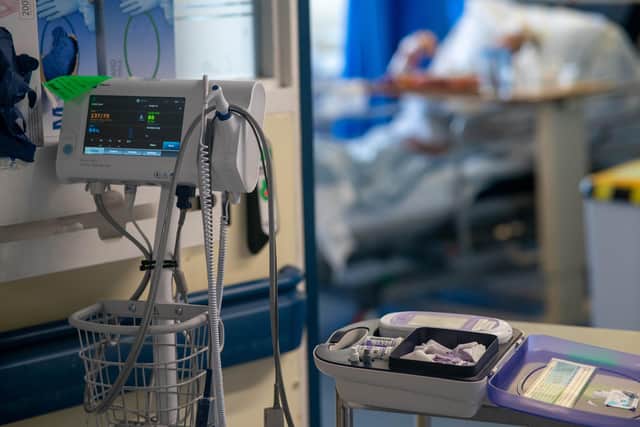

How running Aberdeen Royal Infirmary from Dundee, or Edinburgh or anywhere else furth of Aberdeen will improve healthcare remains as existentially mysterious as Godot himself.
Hugh Pennington, Aberdeen
Focus on patients
Angela Constance makes her case for reducing the number of health boards from 14 to 2 strategic boards in your pages. Is an administrative shuffle the best answer the SNP can provide after presiding over our health services for so many years?
Her article lists the problems: a health and care service tangled in bureaucracy, a discharge team trying to move a patient ten minutes down the road.
Yes, we all know these problems, but the current administration has had plenty of time to sort them. How much longer do they need? The Health Secretary claims she wants this and that. So what is her plan for achieving these, apart from reducing the health board areas? We need more patient care at all levels not a bit of tinkering at the top.
Fiona Garwood, Edinburgh
Get well soon
It is refreshing to see Angela Constance acknowledge that bureaucracy continues to consume resources, but does nothing towards improving patient care, as she outlines her plans for the NHS. Indeed, it reduces the chance of patients getting the care they need when they need it.
However, the SNP has been in charge of the NHS in Scotland for 20 years, so this epiphany about how to improve services to patients could have happened any time in the last two decades which have seen so many cabinet ministers for health, none of whom have delivered major improvements.
I wish her well in her challenge, but if past performance is an indicator of future performance, we should reserve judgment. Perhaps The Scotsman could publish a progress review half way through this parliament, and report on whether the changes she plans to introduce are improving matters, or if it is simply another soundbite to be consigned to history like so many others?
On a positive note, she did not blame Westminster! I guess this means that she may not last long in Mr Swinney’s cabinet.
Brian Barbour, Haddington, East Lothian
US has lost its way
What has happened to the country that once claimed to be the world’s moral compass?
The prospect of America livestreaming an execution by firing squad is a chilling reminder of how far a nation that once championed freedom, democracy and human rights has fallen.
There is something deeply disturbing about a country that lectures others on civilisation and decency contemplating turning state-sanctioned killing into a public spectacle.
This goes beyond capital punishment. It reflects a growing normalisation of cruelty, the erosion of democratic values and a political culture in which vengeance, intimidation and spectacle increasingly replace compassion and restraint.
Under Donald Trump, America’s moral authority is being steadily dismantled, with the values it once proudly defended increasingly cast aside.
A great nation should be judged not by how brutally it punishes, but by the humanity it demonstrates. America risks becoming a grotesque caricature of everything it once stood against.
Alex Orr. Edinburgh
The right to life
Capital punishment is fundamentally unethical because it violates the most basic human right: the right to life, as recognised by international human rights standards. No state should possess the authority to execute its citizens, regardless of the crimes they committed.
From a moral perspective, the death penalty reduces justice to mere vengeance. True justice seeks accountability and potential rehabilitation, whereas execution mimics the very violence it aims to condemn. It forces the justice system to operate on the flawed principle that killing can teach society that killing is wrong.
Furthermore, the practice is inherently cruel, inhuman, and degrading. The psychological torture of spending years on death row, followed by the clinical brutality of the execution itself, constitutes a form of torture that has no place in a civilised society.
Finally, because human judgement is imperfect, the system carries the moral risk of executing the innocent. Taking a life in the name of the law leaves no room for correction, making the death penalty an absolute and irreversible moral failure.
Doug Clark, Currie, Edinburgh
Trump’s pal Putin
During the Vietnam War, 30,000 Canadians crossed the border. into the United States to volunteer for the US military. What did Donald Trump do? He had four draft deferments and one medical deferment for bone spurs in his heels.
Now Trump, who allegedly supports Ukraine, has spoken to his pal Vladimir Putin and helped the Kremlin Killer out by buying 300,000 tons of diesel, 500,000 tons in November and a further one million after that. This gives Putin millions of dollars – badly needed hard currency that will extend the war in Ukraine.
Still involved in the war he started with Iran, in his narcissistic perception of himself he wonders why he hasn’t won the Nobel Peace Prize.
Doug Morrison, Tenterden, Kent
Own goal
I refer to Alan Gall’s letter (1 October) which suggests that Scotland opens its doors to overseas football talent. Alan noted that “Scotland’s 100 per cent native football team is losing to Switzerland which seems to include three Nigerians, one Senegalese, one Angolan, one Chilean and one Albanian. The remaining four may well be native Swiss.”
I question whether Alan’s labelling of these players is consistent with an open-doors welcome. A quick online check confirms that all 11 starting players are Swiss-born and have Swiss nationality.
Rob Curtis, Bo’ness, Falkirk
Rising bills
An excellent letter from E Watt (10 October) which points out that floating wind farm technology fails to provide Scottish consumers with a base load supply of electricity. The result is a dependence on English gas turbine output to keep the lights on north of the Border under dunkelflaute weather conditions.
Note also that as the £217 per MWhr strike price is three times above that of fixed bed units, unit prices for electricity will increase by 14p to a cost of around 40p per unit!
Ian Moir, Castle Douglas, Dumfries and Galloway
Dodged bullet
Brian Wilson is right to commend the testing of SNP ministers’ competence, but he is on the wrong side of the argument over the Scot Wind scandal (Scotsman, 10 October).
The cost to the consumer of the intermittent electricity generated by a wind farm comprises several elements: the essential capital equipment costs;, the costs of the professional services firms that dream up the subsidy mechanism and ensure compliance; the cost of the borrowing required to pay for the equipment; the cost of leasing the seabed; the cost of operations and maintenance; and the developers’ profit and subsidy.
The UK wind farm seabed leases raised £8 billion for government and this sum was added to the tariffs paid by consumers and business over the next 15 to 20 years. It is one of the reasons electricity prices in the UK are amongst the highest on the planet. In the case of Scot Wind, the seabed leases raised £75 million and the impact is a lower tariff paid by householders and business.
The moral case is also with the lower lease cost. £8bn attracts a lot of parasitic costs (accountants, consultants, economists, lawyers, lobbyists), £75m less so. Had the Scottish government raised £8bn from seabed leases, there would have been further increases in the cost of electricity, harming both consumers and business; and most likely there would have been a stalling case for removing inactive civil servants from the Scottish government payroll and the inevitable reckoning between government income and expenditure could have been kicked further down the road and into the next parliament.
Alistair Mackie, Ely, Cambs
Write to The Scotsman
We welcome your thoughts – NO letters submitted elsewhere, please. Write to [email protected] including name, address and phone number – we won’t print full details. Keep letters under 300 words, and in the body of the email – no attachments – and avoid ‘Letters to the Editor/Readers’ Letters’ or similar in your subject line. If referring to an article, include date, page number and heading. No poems.
Comments
Want to join the conversation? Please or to comment on this article.