
A Blue Tsunami, or will the Red Wall hold? The US midterms by the numbers
Democrats are expected to do well in the House and the Senate - but face an uphill task nevertheless
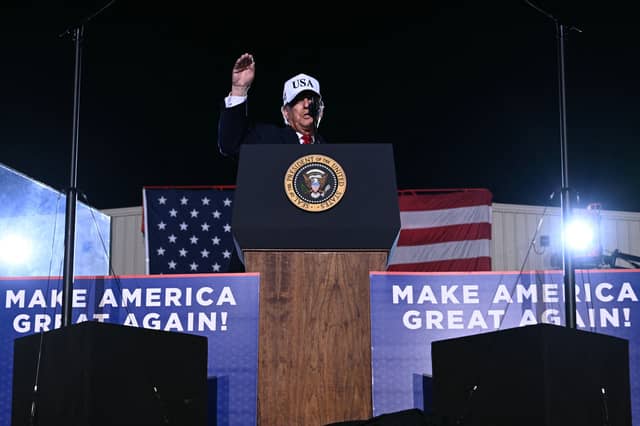

Every two years, halfway through a president’s four-year term, Americans vote in the midterm Congressional elections. President Donald Trump is not on the ballot, making Congress – which makes the laws and holds the purse strings – the central focus. Here are some numbers worth knowing.
3 and 4
These are the number of additional seats the Democrats need to gain to win majority control of the House of Representatives and the Senate respectively, the two chambers that make up the Congress. This may sound easily achievable, but the numbers are deceptive.
Take the House first. A majority needs 218 of its 435 seats. The 2024 elections left the Democrats three seats short of the majority. In a normal midterm that would be easy, but this is not a normal midterm. Unusually, ten states have redrawn their constituency boundaries since 2024 to advantage the parties controlling those states. On paper the new maps favour Republicans in about 15 seats and Democrats in about six. In effect, the Democrats must win back lost ground before they even start gaining it.
The Senate is harder still. Only a third of its 100 seats are up for election, and Republicans hold 53. A 50–50 split is not enough for Democratic control, because the Vice-President, JD Vance, casts the deciding vote, so Democrats need a net gain of four seats (and possibly five as there is speculation Pennsylvania’s Democratic Senator John Fetterman may change sides). The problem is where those seats are.
To get the gains they need, Democrats must win at least two states that Mr Trump carried by double digits in 2024. As the New York Times’s Nate Cohn notes, no party has flipped a seat leaning 13 points the other way in a regularly scheduled election since 2010.
So whilst it may sound easy, the Democrats have an uphill fight, however…
READ MORE: John Swinney says foreign trip critics 'have no understanding of selling Scotland to world'
26
That is the average number of seats in the House lost by the president’s party in the 20 midterms since 1946. It has lost seats in all but two of them. Why? Part of the answer is turnout. Supporters of the president’s party tend to feel less urgency two years on and stay home, whilst the opposition party is fired up. Some voters also seem to like the idea of a check on whoever holds the White House. The two exceptions to this rule, 1998 and 2002, came when presidents Bill Clinton and George W Bush were enjoying approval ratings in the mid-60s.
35
Mr Trump’s average approval rating across the polls stands at around 35 per cent. That is lower than any president heading into a midterm since Harry Truman in 1946, whose party lost 56 seats. Gallup has reported that when a president’s approval is below 50 per cent, his party loses an average of 37 House seats.
$4.27
This is the current average price of a US gallon of petrol – roughly $1.13 (84p) a litre.
Whilst that may sound ridiculously cheap to Scottish drivers, it is roughly 39 per cent more expensive than a year ago. And diesel – vital for the agriculture and transport sectors – is up by more than 70 per cent. Inflation is back up to 3.7 per cent.
Perhaps unsurprisingly, only 19 per cent of Americans approve of Mr Trump’s handling of the cost of living.
$11.21 billion
The amount spent on, or booked for, political advertising this election cycle. This is a record for all elections in the US and surpasses even the 2024 presidential cycle. In the UK, spending by parties and candidates is capped; in the US, so-called super PACs (political action committees) can raise and spend unlimited sums, provided they do not coordinate with the candidates they support. Elon Musk alone has given about $446 million to Republican groups, reportedly making him the largest individual political donor in American history. Two of his cheques to the Republicans’ main Senate super PAC, totalling $158 million, were passed to a group backing Ken Paxton in Texas, where spending has passed $560 million – a record for any Senate race.
54.5 million
Roughly the number of Americans who had already voted by Sunday, 1 November.
Most states let people cast their ballot in person or by post in the weeks before polling day, and the early vote is running well ahead of the 2022 midterm elections.
Registered Democrats were out-voting registered Republicans by about 11 per cent in the 27 states that publish party figures. There is an important caveat, though: we do not know who these early voters supported.
So what should we expect? The poor public evaluations of the economy and Trump’s job performance point to large losses for Republicans across the board and a Democratic blue tsunami. But the Republican’s massive spending advantage, political control and gerrymandering may have built a substantial Republican red wall.
The political scientist John Sides has averaged 64 academic and media election forecasts. All 31 House forecasts point to the Democrats having a probability of around 90 per cent in gaining a majority, with an average prediction of 239 seats (recall 218 are needed for control). Control of the Senate, according to the forecasters, is far less certain. On average, the models give the Democrats about a 66 per cent of winning a majority, on just about 52 seats.

And it may be several days after the polls close (if not longer) until we know which party will control each chamber. The states use different rules in running their elections and counting their votes. Some states, such as Florida and Texas, tend to be fast reporting results; others, such as California and Alaska, tend to be excruciatingly slow. Add to that the very real possibility of recounts and accusations of vote tampering.
In both 2022 and 2024, it took over eight days until we knew which party would control Congress. We shouldn’t expect much different out of these midterm elections.
Christopher Carman is Stevenson Professor of Citizenship at the University of Glasgow
Comments
Want to join the conversation? Please or to comment on this article.