
Keir Starmer calls for calm in face of ‘era of global instability’ following Donald Trump’s tariffs

The Prime Minister announced fresh support for industry
Sir Keir Starmer has called for calm in the face of an “era of global instability” as Donald Trump threatened additional tariffs on China - raising fresh concerns the US president’s drive to rebalance the global economy could lead to a trade war.
The Prime Minister said the UK had to “rise together as a nation” as the value of UK stocks plummeted along with those in the US, Europe and Asia.
Mr Trump's threat, which he delivered on social media, came after China said it would retaliate against US tariffs announced last week.
"If China does not withdraw its 34 per cent increase above their already long term trading abuses by tomorrow, April 8th, 2025 , the United States will impose ADDITIONAL Tariffs on China of 50 per cent, effective April 9th ," he wrote on Truth Social.
"Additionally, all talks with China concerning their requested meetings with us will be terminated!"
If Mr Trump implements his plans, US tariffs on imports from China would reach a combined 104 per cent.
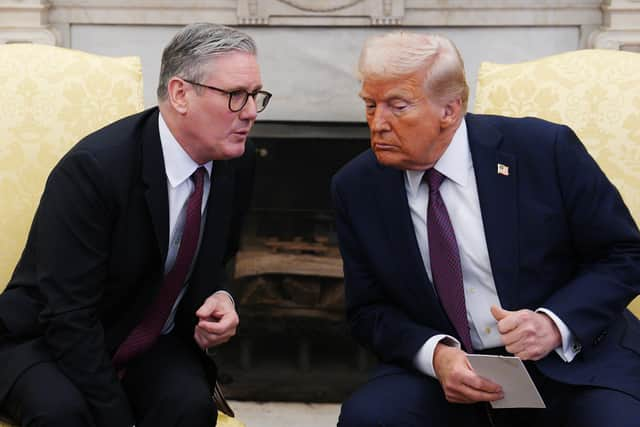
Meanwhile, First Minister John Swinney demanded a “big and a bold response” from the UK and warned businesses were facing a “double whammy” of tariffs on sales to the US and increased national insurance charges for employers.
Sir Keir made his comments while announcing an easing of net zero measure on the automotive industry, which is facing a 25 per cent tariff on sales to the US.
Speaking at a Jaguar Land Rover plant in the West Midlands, Sir Keir said: “These are challenging times, but we have chosen to come here because we are going to back you to the hilt.
“This is a moment for cool heads, nobody wins from a trade war, you know that.
“But it’s also a moment for urgency, because we’ve got to rise together as a nation to the great challenge of our age – and it is the great challenge – which is to renew Britain so we’re secure in this era of global instability.”
He said the visit was a “statement of intent”, showing the government’s support for the industry.
Sir Keir said “this is not a passing phase” and was a “completely new world”, with the economic turbulence following the defence and security instability caused by the war in Ukraine.
He added: “Let me be really clear, at a moment like this, our future is in our hands, and so of course, we will keep calm and fight for the best deal with the US, and we’ve been discussing that intensely over the last few days.
“But we are also going to work with our key partners to reduce barriers to trade across the globe, to accelerate trade deals with the rest of the world, and champion the cause of free and open trade right across the globe.”
Meanwhile, European Commission chief Ursula von der Leyen said Europe is ready to negotiate with Washington, over "zero-for-zero tariffs" for industrial goods the bloc exports to the US.
The Prime Minister hopes to be able to strike an economic deal with the White House to ease the tariffs imposed by Mr Trump.
Markets on Wall Street fell steeply as they opened before rallying, while in London the FTSE 100 hit its lowest level for a year.
Mr Trump showed no sign of changing course, urging people to “be strong, courageous and patient”, promising that “greatness will be the result”.
The president has imposed a 10 per cent tariff on US imports of British goods, along with the 25 per cent tariff on cars and separate import taxes for steel and aluminium.
The Prime Minister announced extra flexibility in the zero emission vehicle (Zev) mandate as the automotive industry phases out petrol and diesel cars an vans.
Sales of hybrid cars will be allowed to continue until 2035, although the Government confirmed the sale of purely petrol or diesel-powered cars will be banned from 2030.
Asked whether other green initiatives could be eased to protect businesses, Sir Keir said “there’s a global race on for the jobs of the future in relation to net zero” and “I don’t think now is the time to step away from that race”.
But he said: “We’re not ideological, we’re pragmatic. If there’s flexibilities that help, which is what we’ve done today in important times for JLR, of course we will take those steps.”
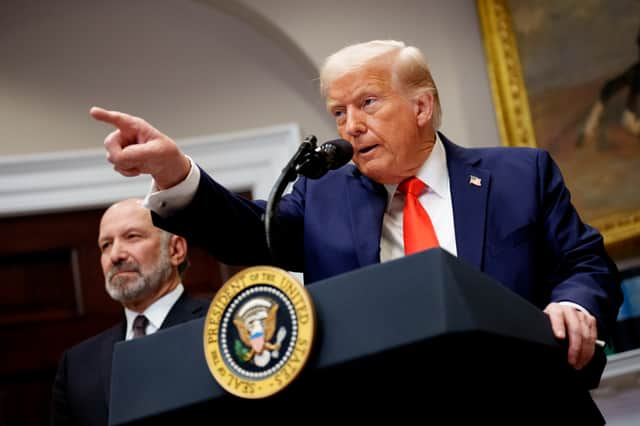
Responding to the Prime Minister’s speech, the Liberal Democrat Leader Sir Ed Davey accused ministers of “cowering” to the US President, and repeated his calls for a closer relationship with Europe.
He said: “Donald Trump has launched an assault on the global economy which threatens thousands of British jobs and family finances with another pasting in the midst of a cost of living crisis.
“The Government needs to break from its policy of cowering in the corner and stand tall with our Commonwealth and European allies against Trump’s tariffs through a new economic coalition of the willing.
“The strategy of hoping Donald Trump will be nice to us has not survived contact with reality. Now is the time to show the White House we have alternatives and end this trade war through strength not timidity.”
There was also criticism from Conservative Party leader Kemi Badenoch, who said Sir Keir is “not doing very much yet” in response to US tariffs.
She added: “What we want to see is a trade deal that helps lower the tariffs.
“He has made an announcement today about reducing the targets for the zero electric vehicles mandate. That’s something he should have done a long time ago.”
Elsewhere, the Reform UK leader Nigel Farage, who has long supported Mr Trump, admitted he thought the tariffs were “a bit excessive”.
He said: “He promised he’d do it in the run-up to the American election.
“So you can’t say he’s breaking his promises, but I think the impact of it – my own view is the impact of it has been bigger than he could have predicted.”
He added he speaks to Mr Trump “far less” now than he did during his first term as US president.
Mr Swinney called on Chancellor Rachel Reeves to rewrite her fiscal rules in light of Mr Trump’s tariffs announcement last week.
He also urged the UK government to reverse the increase in employer national insurance contributions, which came in on Sunday.
Speaking while in New York to promote Scottish business as part of the city’s Tartan Week celebrations, Mr Swinney said there was now a “huge amount of debate and volatility around the imposition of the tariffs regime last week”.
He added: “I recognise the seriousness of this and the damage that could be done by that approach.”
While he stressed his discussions with businesses in the US had given him a “great deal of encouragement and confidence about Scotland’s attractiveness” to investors, Mr Swinney stated that the global outlook is “challenging” for trade.
He said: “The economic landscape has changed dramatically by the tariff announcement last week, and it needs to have a big and a bold response from the UK government, who control macroeconomic policy and international trade.
“Companies in Scotland are facing a double whammy of tariffs in relation to the United States and the economic implications of those tariffs, alongside a significant rise to business costs through employers’ national insurance contributions.”
Comments
Want to join the conversation? Please or to comment on this article.