
John Swinney signals major shift in SNP's position on new oil and gas

The First Minister said events in the Middle East had changed the ‘dynamics’ of the debate
John Swinney has signalled a major shift in the SNP's position on new oil and gas developments due to the "huge volatility" caused by the war in Iran.
The First Minister said the disruption in the Middle East had changed the "dynamics" of the debate around developments such as Rosebank and Jackdaw.
The comments mark a clear departure from the position taken by his predecessors, Nicola Sturgeon and Humza Yousaf.
Decisions over North Sea licensing are reserved to the UK government, but Mr Swinney recently called for power over energy to be transferred to Holyrood.
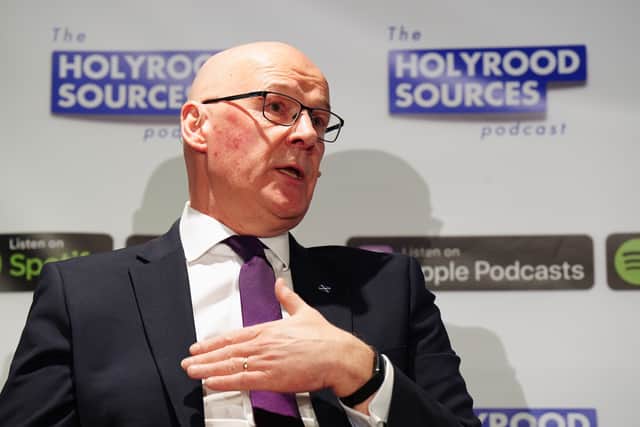

During an event held by the Holyrood Sources podcast in Edinburgh, Mr Swinney was asked whether he would back plans to develop the huge Rosebank oil field off Shetland and the Jackdaw gas field 150 miles east of Aberdeen.
The First Minister said: "The circumstances around these decisions rely on certain key factors that have got to be tested, which is whether or not either of these projects are compatible with our commitments on emissions and our journey to net zero."
He added: "That assessment on climate compatibility has to be undertaken. But I think the thing that's changed is the geopolitical situation that is surrounding us just now, and the huge volatility that we're now dealing with.
"One of the other factors that we've always said has to be looked at in this question is around energy security, and I think there is now much greater uncertainty about energy security as a result of what I would consider to be an illegal intervention in Iran and all the chaos that's been created in our global markets as a consequence. So I think the dynamics of that change as a consequence.
"I can't give you a definitive answer about Jackdaw and Rosebank because the climate compatibility assessment has got to be undertaken.
"But what I'm saying to you is that I think we've got to look at the geopolitical situation we now face and recognise that we are experiencing much greater risk to our energy security as a consequence of what's happening there, and also because there is not an elegance, as I have referred to it, in the transition to a new renewables future."
Mr Swinney said imported oil and gas could be more damaging to the climate, while supply could also be disrupted, such as by events in the Middle East.
"I think that context changes the balance of arguments,” he said. “What we have always said in all of our communications about oil and gas is that there must be a climate compatibility assessment undertaken, indeed as I've said already, I think that's now required by law.
"And secondly we must be very, very mindful of the issues on security of supply, which is now in a more perilous position today than it was if we were having this conversation four weeks ago.”
The First Minister added: "We're going to have to use hydrocarbons for some time to come. And if we are importing that, and that is a higher carbon threshold than domestic production, then we've got to - my argument would be we should prefer domestic production over imported production.
"And also that we take into account the impact of energy security questions on our ability to be confident that we can actually source that oil and gas in the years to come."
In 2023, Ms Sturgeon said she agreed with former Green Party leader Caroline Lucas that Rosebank was “the greatest act of environmental vandalism in my lifetime”.
Mr Yousaf, her successor as first minister, said a decision to approve its development - later overturned by the courts - was “wrong”.
The UK government continues to consider whether the development of the oil field can go ahead. It is the UK’s largest untapped field, containing up to an estimated 300 million barrels of oil.
Comments
Want to join the conversation? Please or to comment on this article.