
Scotland exam results: Ministers under pressure for failing to close poverty-related attainment gap

Attainment has risen in the last year but the gap between pupils from the wealthiest and most deprived backgrounds remains almost static
Ministers are facing increasing pressure to close the poverty-related attainment gap as a crucial government-set target looks certain to be missed.
Scottish Qualifications Authority (SQA) results show the level of attainment across National 5, Highers and Advanced Highers increased in 2025 compared to last year.
But figures released by the SQA also show the gap between pupils from the wealthiest and most deprived backgrounds remains almost static, closing by just 0.1 percentage point.
In 2015, while First Minister, Nicola Sturgeon pledged the elimination of the attainment gap was “a yardstick by which the people of Scotland can measure our success”, and the 2016 Programme For Government said the disparity would be significantly reduced by 2026.
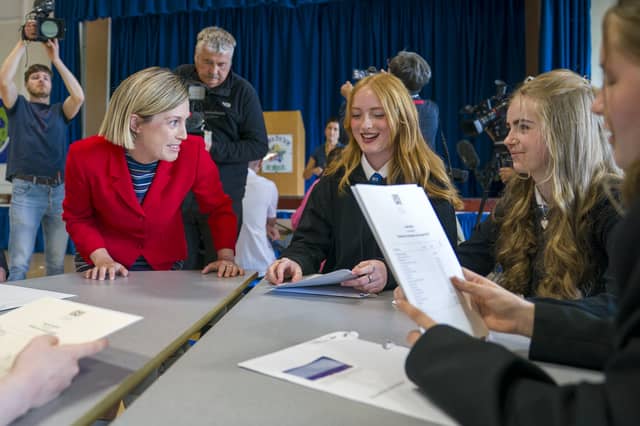
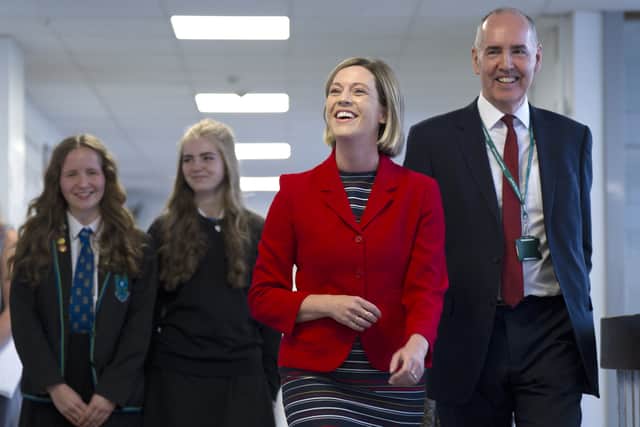
On a visit to meet pupils at Glasgow’s King’s Park High School, Education Secretary Jenny Gilruth said progress had been made but cited the pandemic and austerity measures from Westminster governments.
She said the country now has a “markedly different” education system than existed in 2016 and making direct comparisons is “challenging”.
“A decade on we’ve had a global pandemic. We've also had austerity policies which have harmed some of our most vulnerable families.
“And I'm always struck by that in my school visits, the normalisation of anti-poverty policies within our schools now.”
Ms Gilruth said that when she was last teaching, around 15 years ago, anti-poverty measures did not exist in classrooms.
“So our schools are stepping up to that challenge,” she added.
“They're having to use resources like the Pupil Equity Fund (PEF), which has come from that funding that Nicola Sturgeon committed to, that they should not have to be doing.”
Ms Gilruth pointed again to the slight narrowing in attainment gap figures and said that progress “should be supplemented” by progress in literacy and numeracy in primary schools.
“We also see the narrowing of the poverty related attainment gap in terms of positive destinations, which have narrowed since 2009 and 2010 by two thirds,” she added, pointing to UCAS data that shows more young people from poorer backgrounds are going on to university.
The number of 18-year-olds from Scotland’s most deprived areas securing places at university has increased by 100 to 1,960, which is a record high.
The number of young Scots who have secured a place at university this year has also increased to a new high of 16,340 acceptances for 18-year-olds, up four per cent on last year.
Scottish Labour Education Spokesperson Pam Duncan-Glancy called the SNP’s fudging of the 2026 target “damning”.
“Almost a decade on and SNP ministers are refusing to own up to Scots that they have repeatedly made promises that they are unable to deliver upon,” Ms Duncan-Glancy said.
“Education is a devolved matter and the responsibility of the Scottish Government, and yet Jenny Gilruth instead chooses to make excuses for the SNP’s atrocious record.
“Scotland’s young people are being held back by a failing SNP government, with ministers consistently shirking responsibility for their own failures.”
Scottish Conservative shadow education secretary Miles Briggs also said “no amount of spin” could detract from the failure to eradicate the attainment gap.
SQA results show that the gap between the most and least deprived pupils obtaining A to C grades at National 5 was 16.6 per cent, with the gap at Higher 17.1 per cent and Advanced Higher standing at 12.8 per cent.
For Higher, this is a shift of 0.1 per cent from 17.2 per cent last year.
The gap between the most and least deprived pupils achieving A grades at Advanced Higher has widened by almost three per cent since prior to the pandemic.
Mr Briggs said: “Frankly, no amount of spin from them can avoid the fact that Nicola Sturgeon’s promises in relation to the attainment gap lie in tatters.
“She wanted to eradicate it completely yet still there is a huge gap in the results achieved by those from our most and least deprived communities.
“It should be a source of shame for Nicola Sturgeon and John Swinney that those from the most deprived communities are still facing a postcode lottery when it comes to educational achievement.”
In Glasgow, which faces some of the worst rates of deprivation in Scotland, Advance Higher attainment has seen a marked increase.
The number of S6 pupils achieving one or more qualification at that level rose by 1.4 per cent.
This is despite the closure of a specialist facility at Glasgow Caledonian University designed to help pupils from disadvantaged backgrounds study for Advanced Highers.
Douglas Hutchison, executive director of education at Glasgow city council, said the local authority had moved to share resources between secondary schools to ensure pupils did not miss out.
Some young people will travel to other schools in the city to study subjects not available at their own secondary.
Mr Hutchison said: “Our consortium arrangements have worked out really well and the evidence of that is in the increased attainment.”
He added that additional resource is necessary in schools to make a significant difference to attainment figures.
“We've got great teachers in our schools,” he said.
“It's the additional support around teachers to make their life a bit more straightforward that has been eroded over the years in different ways.
“But I do think things are going in the right direction.”
This year’s Higher pass rate is 75.9 percent, an increase of one percentage point compared to the previous year.
Other than 2019 and 2024, it is the lowest Higher pass rate in the past 15 years.
Results have fallen from the record highs of 2023 but have increased on last year.
The pass rates for National 5 and Highers were similar to pre-pandemic levels but for Advanced Higher dropped to 3 per cent lower than in 2019.
The number of pupils with an A to C grade for National 5 qualifications rose from 77.2 per cent last year to 78.4 per cent this year.
The rate for Higher increased from 74.9 per cent to 75.9 per cent, while the rate for Advanced Higher rose from 75.3 per cent to 76.7 per cent.
Comments
Want to join the conversation? Please or to comment on this article.